Return To Work Services

Supporting safe, timely and sustainable return to work outcomes.

Workplace injuries can have significant financial, operational and human impacts on organisations. Actevate supports employers by providing specialised return to work and rehabilitation services that help injured employees recover safely while reducing the long-term impact of workplace claims.

Trusted By Leading Companies in Australia
WHAT IS RETURN-TO-WORK

Outsourced Return to Work Coordination.

Prevention is always the goal. But injuries happen, and when they do, every week a claim drifts costs your business money and costs your worker their best chance of recovery. Actevate is the independent, Australian-owned rehabilitation provider that gets people back safely and sustainably.

Our multidisciplinary team works collaboratively with employers, employees and medical professionals to develop practical strategies that support recovery while minimising disruption to the workplace. This approach leads to:

Reduced claim costs
Shorter injury life cycles
Safer and more sustainable return to work outcomes
THE COST OF WAITING

A claim doesn’t stand still. It drifts (and drift is expensive)

Safe, swift and sustainable return to work has never mattered more: return to work rates are falling nationally, the cost of rehabilitation keeps rising, and the longer a claim runs, the worse the outcome for everyone. Here’s what the drift looks like.

WHY CHOOSE US

A whole-person model that supports recovery and reduces claim escalation.

Actevate takes a whole-person approach to injury management and rehabilitation. We recognise that both physical and psychological factors influence recovery and return to work outcomes.

Through early intervention and proactive risk identification, we help prevent minor injuries from escalating into complex claims.

OUR UNIQUE APPROACH: PATHWAYS

We see the secondary psychological injury coming before it arrives.

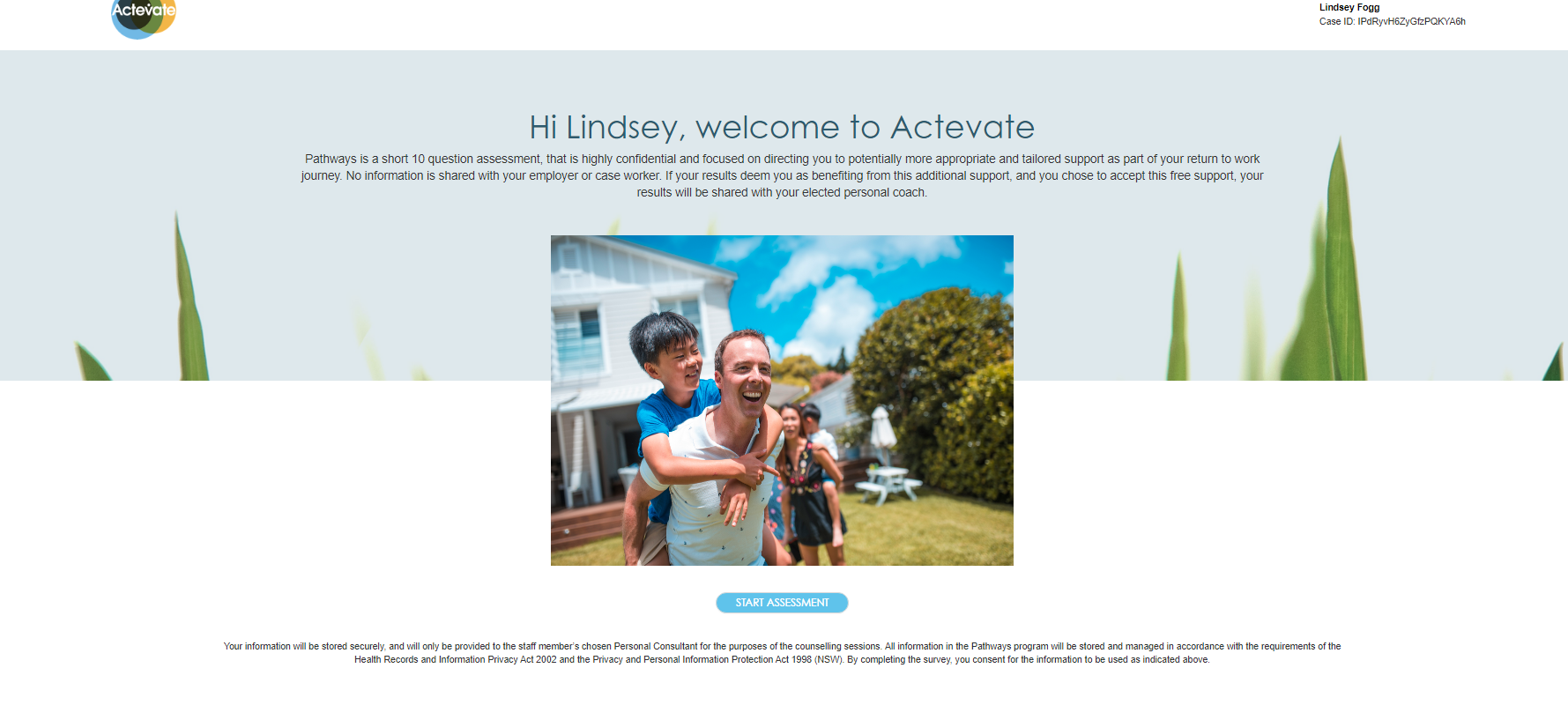
Pathways is Actevate’s innovative digital screening solution, built to identify workers whose recovery and employment are likely to be compromised by mental health factors or a reduced desire to return to work.

That early warning lets us work with all stakeholders to find a solution for all parties, before a straightforward physical claim becomes a complex psychological one.
Recipient of State & Federal Government grants
YOU RIGHT TO CHOOSE

Did you know you can nominate your preferred rehabilitation provider?

Many employers don’t realise they have a say in which workplace rehabilitation provider supports their claims. You do. The choice of provider is discussed between you, your worker and the insurer, and you’re free to nominate Actevate from the start of a claim or request a change on an existing one.

We work in partnership with insurers every day and many of our referrals come directly from them. Nominating us doesn’t put you at odds with your insurer. It simply puts a provider you’ve chosen on your claim.
Nominate Actevate as your preferred provider
PARTNERING WITH US

Already have someone managing Return to Work internally?

Choosing outsourced health and safety is not the same as replacing your internal resources. Many of our clients at Actevate have some form of in-house capabilities (often an HR lead, office manager, or facilities coordinator) who fits health and safety in around their main job function. What the outsourced service does is multiply what that person can achieve.

We act as an extension of your team. We bring the strategic frameworks, regulatory expertise, and specialised tools that your in-house champion needs to stay compliant.

WE MANAGE THE END-TO-END PROCESS

Our Return to Work services also include:
Workplace Assessment

We identify physical, ergonomic, and environmental requirements of a specific role. We assess a worker's pre-injury duties to help in identifying how we can help you get that worker back as safely and

Functional Assessment

Accurately determines the worker's current physical abilities as opposed to relying on a subjective assessment of capacity often issued by the worker's doctor.

Medical Case Conference

We are your eyes and ears when and where it counts most. Actevate's allied health team don't simply turn up to medical case conferences to accompany your worker.

Activities for Daily Living

The aim of our ADL assessment is to identify the self-care needs and modifications necessary for a worker to function as independently as possible in their home while recovering from injury.

Psychological Assessment

Need to identify whether the worker's psychological condition is related to work? Our team of Psychologists can with psychological stress claim evaluation and pre-liability assessments.

Mind Body Training

Actevate's MindBody Pain Management program Mindgain is at the forefront of scientific research into pain prevention and injury treatment.

FAQ

Frequently Asked Questions

What is a return to work program?

Why use Actevate for return to work services?

When should I engage a return to work provider?

What if we have in-house injury management capacity?

Our insurer already appoints rehabilitation providers. Why choose our own?

We only have a few claims a year. Is it worth it?

What are suitable duties?

What is an employer's role in return to work?

This is arguably the defining theme of 2026. Safety is no longer just hard hats and harnesses. A growing number of organizations now recognize that true safety must include mental health, psychological safety, remote work conditions, and inclusive practices, expanding the EHS mandate far beyond the factory floor.

Kathryn Franklin

Director

Sitting on open claims?
Let’s chat.

Tell us about the claim and a return to work specialist will call you back within one business day. Refer directly by emailing hello@actevate.com.au.

Early intervention
Minimise costs
Coordinated care
Prevent secondary injury
Specialist support
Better recovery outcomes
Prefer to talk now? Call 1300 663 155
Step 1
Fill out this form to let us know what you’re looking for.
Step 2
Our team will be in contact to set up a chat within 24 hours.
Thank you. We have received your request. A member of our team will be in touch.
Explore our blog posts
Oops! Something went wrong while submitting the form.
August 20, 2026
5 min
The Mental Health Matters Awards are on Friday 25 September

Wayahead Mental Health Matters Awards 2026

Actevate is proud to be sponsoring the Leadership in Workplace Psychosocial Safety Award at the 2026 Mental Health Matters Awards, hosted by Wayahead Mental Health Association NSW.

This award recognises a workplace initiative or program that shows outstanding commitment to creating safe and supportive work environments, and it celebrates the organisations going well beyond compliance to champion proactive, innovative and evidence informed approaches that reduce psychosocial risk.

Nominees are judged on whether psychosocial safety is genuinely embedded in everyday practice through strong governance, inclusive culture, meaningful worker participation and systems that prevent harm.

The Awards pull together senior leaders, HR and WHS decision makers, clinicians, policy people and lived experience advocates from across NSW, which makes it one of the more useful rooms in the sector calendar.

Speaking this year:

The Hon. Rose Jackson MLC
NSW Minister for Mental Health, who has held the portfolio since 2023 and is responsible for the delivery and development of mental health services across the state.

Mitch Brown
Former West Coast Eagles player with 94 AFL games to his name, now a mental health advocate who speaks on inclusion, authenticity and positive masculinity through his own lived experience.

Info: The event is a great opportunity for networking with fellow mental health advocates and connecting with likeminded leaders across sectors.

Actevate's category sits alongside seven others recognising work across the sector:

  • Leadership in Workplace Psychosocial Safety Award, sponsored by Actevate
  • Mental Health Matters Youth Award, sponsored by the Office for Youth
  • Mental Health Matters Community Initiative Award, sponsored by Beyond Bank
  • First Nations Social and Emotional Wellbeing Award, sponsored by the Mental Health Commission
  • Julie Leitch Leadership through Lived Experience Award
  • Outstanding Achievement in Mental Health Promotion Award
  • Mental Health Matters Media and the Arts Award
  • Mental Health Matters Rainbow Inclusion Award

Event details

  • Date: Friday 25 September 2026
  • Time: 11:30am to 3:30pm
  • Venue: Grand Ballroom, Four Seasons Hotel Sydney, 199 George Street, The Rocks
  • Includes: two course sit down lunch with drinks
  • Dress code: semi-formal

Buy a ticket

Individual seats and full tables are on sale now, and a table is worth considering if you want to bring your leadership group or WHS committee along.

Note: Tickets are sold through Humanitix, which directs 100% of its booking fee profits to charity. Payment plans are available if you would rather spread the cost of a table.

Book your tickets or table

If you are coming along, come and find our team to say hello.

All
August 20, 2026
5 min
SafeWork NSW releases free due diligence tools for officers

SafeWork NSW has published a set of practical online tools to help officers understand and meet their due diligence obligations under the Work Health and Safety Act 2011. At Actevate we welcome the release, because it turns a duty that many officers find abstract into something they can actually check themselves against.

The feedback we hear from our own clients is consistent. Officers understand that due diligence is a legal obligation. What they are far less certain about is what it looks like in day to day decision making, and what a regulator would accept as proof that they were exercising it.

Info: The self-assessment tool is free and takes only a few minutes. It is a capability building exercise, not a compliance check, and completing it does not trigger any regulator action.

Who counts as an officer

This is the first thing organisations tend to get wrong. Due diligence does not sit with the WHS team. It sits personally with the people who make, or take part in making, decisions that affect a substantial part of the business.

In practice that usually means:

  • Company directors
  • Chief executives and executive leadership
  • Senior managers with genuine decision making authority over resources and operations
  • Certain partners, office holders and public sector equivalents

Note: The duty is personal and it cannot be delegated. An officer can appoint a safety manager and still be liable, because appointing someone is not the same as verifying that what they have built actually works.

The six reasonable steps

SafeWork NSW frames due diligence as taking reasonable steps across six areas. The genuinely useful part of this release is that the regulator has now spelled out, for each step, the records an officer should be able to produce.

1. Acquire and keep up to date WHS knowledge

Annual WHS governance training for officers, quarterly briefings to the board on emerging hazards such as psychosocial risk, and keeping current with code of practice updates.

Records: officer training records, board skills matrix, briefing packs on WHS law updates.

2. Understand the operations and their hazards

Structured officer site visits to high risk locations, and periodic deep dives on critical risks aligned to the approved codes.

Records: visit logs with observations, risk registers, critical risk heat maps discussed at board or executive level.

3. Ensure appropriate resources and processes are in place

Approving and tracking budget for controls, and making sure there is enough WHS capability and frontline staffing to run operations safely.

Records: capital requests tied to risk assessments, staffing plans, maintenance records for safety critical controls.

4. Ensure incidents, hazards and risks are received and responded to in time

Escalation of notifiable incidents and overdue actions to executives against response time targets, with a clear workflow covering who analyses, who decides, by when, and how closure is verified.

Records: incident trend dashboards, action closure reports, minutes evidencing decisions and timeframes met.

5. Ensure processes exist for complying with WHS duties

Incident notification, worker consultation, compliance with notices, training and instruction, and health and safety representative training entitlements.

Records: procedure suite, training matrices, consultation records, licence schedule, notices register.

6. Verify that steps 3 to 5 are actually working

This is the step most often missed. Verification means actively confirming through audits, inspections and follow through, rather than passively receiving reports.

Records: audit plans and reports, corrective action logs, a decision and participation register cross referenced to board minutes.

Tip: Read step six as the test the other five are marked against. Most officers we work with can evidence resourcing and process. Far fewer can evidence that they checked whether any of it worked.

What the self-assessment gives you

The tool is a short questionnaire covering how effectively you are exercising your responsibilities. On completion you receive:

  • Insight into your current due diligence practices
  • Your strengths and your opportunities for improvement
  • Tailored, prioritised actions to strengthen your safety leadership

SafeWork NSW has also published a short quick reference guide covering the fundamentals: who may be an officer, what the specific duties are, and the practical steps available to strengthen compliance. It is worth reading before you start the assessment rather than after.

Why this matters now

Two changes make this release more consequential than it first appears.

Approved codes of practice became directly enforceable in NSW from 1 July 2026. Where your systems depart from a relevant code, you now need documentation showing your approach provides an equivalent or higher standard. And psychosocial risk remains a headline SafeWork NSW regulatory priority, with the Managing Psychosocial Hazards at Work code the enforceable benchmark.

Officers should also be aware of the personal exposure. Where an organisation fails to comply with a WHS duty and that failure is attributed wholly or partly to an officer failing to meet their section 27 duty, the officer may be found guilty of an offence, separately from the business.

Note: A completed self-assessment is not itself evidence of due diligence. It shows you where the gaps are. Closing and documenting them is the part that counts.

Access the resources

How Actevate can help

The self-assessment will tell you where your gaps are. It will not close them. That is the work we do with officers and executive teams.

  • Psychosocial risk gap assessment. We assess your current systems against the enforceable code and give you a documented position on where you stand and what to fix first.
  • Officer and leadership capability. Our mental health training builds the capability step one asks for, giving leaders the skills to recognise psychosocial hazards and respond early.
  • Evidence you can point to. We help you build the consultation records, risk registers and review cycles that make step six defensible.

If you have completed the self-assessment and want to talk through the result, call 1300 663 155 or get in touch.

This article summarises SafeWork NSW guidance current as at August 2026. It is general information, not legal advice. Officer obligations depend on your role and circumstances. For advice on your specific position, speak to Actevate or a qualified legal practitioner.

All
July 23, 2026
5 min
SafeWork NSW's Regulatory Priorities for 2026-27

SafeWork NSW recently released its Regulatory Statement for 2026-27, confirming the four areas that will drive its inspection and enforcement activity over the next 12 months.

The Statement sets out the work health and safety risks, industries and behaviours that will attract the regulator's attention this financial year. For any business operating in New South Wales, it is a clear indication of where inspector visits, audits and compliance action will be directed.

The priorities are largely consistent with the past two years. SafeWork NSW Commissioner, Janet Schorer, has indicated that this continuity is deliberate, and that businesses in the priority areas should be examining what is working well in their safety systems and what needs to improve.

"Since becoming a standalone regulator, we’ve not seen much of a change in our regulatory priorities between 2025/26 and 2026/27. This signals to me that, while we have work to do as a regulator, it’s also important for businesses in those key priority areas to think really seriously about their work health and safety in terms of what is working well and what needs to be improved."

- Janet Schorer

Enforceable Codes of Practice

Amendments to the Work Health and Safety Act 2011 (NSW) came into effect on 1 July 2026, giving legal force to approved Codes of Practice. Until now, Codes have operated as guidance material that inspectors and courts could reference when assessing what was reasonably practicable. They are now directly enforceable.

If your safety management system does not align with a relevant approved Code, you will need to demonstrate that your approach provides an equivalent or higher standard of protection, and you will need documentation to support that position.

We suggest a documented gap analysis against each Code that applies to your operations, completed this quarter. Where your systems depart from a Code, businesses should record the rationale and the evidence that your alternative approach meets or exceeds the standard.

Psychosocial risk

Psychosocial risk remains a headline priority, and the supporting data explains why. SafeWork NSW received more than 2,200 requests for service and over 190 incident notifications relating to psychosocial hazards in the past 12 months.

The regulator's focus for 2026-27 falls in two areas.

Risk factors leading to harmful behaviours

This includes bullying and harassment, with attention on high-risk workplaces and occupations.

Preventing violence and aggression towards frontline and customer-facing workers

This has been flagged as a specific sub-priority. Organisations in health, education, retail, hospitality, community services and government should take particular note.

In our experience, the gap for most organisations is not intent but evidence. Policies, values statements and employee assistance programs are valuable, but they do not constitute a psychosocial risk management system, and they will not satisfy an inspector on their own.

Note: The Managing Psychosocial Hazards at Work Code of Practice is now the enforceable benchmark in NSW.

A defensible system involves identifying hazards through consultation, surveys and incident data, assessing and prioritising those hazards, implementing controls at the source of the risk rather than relying on individual coping strategies, and reviewing controls as the organisation changes. It also requires leaders and managers who are trained to recognise psychosocial hazards and respond to reports early. Effective risk management requires capability and capacity, at all levels, across operational teams and support functions.

Falls from heights

Falls from heights remains the leading cause of traumatic injury in NSW workplaces, with over 600 incidents and five fatalities reported in the past 12 months. SafeWork NSW will maintain its focus on residential construction and will extend its attention across the construction supply chain, including officers, principal contractors and supervisors.

Businesses that engage contractors should note that their duties extend beyond induction. The regulator expects evidence of capability across the chain, which means verifying that contractors' safe work method statements reflect actual practice rather than sitting in a file.

Hazardous substances

The focus here is exposure to crystalline silica, particularly in tunnelling and infrastructure projects, and asbestos in construction. In the past 12 months, inspectors issued more than 145 silica-related notices and received over 45 reports of silicosis cases.

Businesses with workers engaged in high-risk crystalline silica processing work should confirm strict compliance with the notification requirements of the Silica Worker Register, which commenced on 1 October 2025. This is an area where the regulator is actively checking records, and gaps are straightforward for an inspector to identify.

Mobile plant, vehicles and fixed machinery

Preventing injury from mobile plant, vehicle rollover and access to moving parts of machinery remains a priority, with agriculture, construction and manufacturing named as focus industries. The regulator was notified of over 500 incidents and eight fatalities related to mobile plant in the past year. Traffic management, exclusion zones, guarding and operator competency should all be reviewed against current practice.

Across all four priorities, the Statement reinforces three expectations that apply to every duty holder.

The first is genuine consultation with workers about WHS risks and decisions that affect their health and safety. You must be able to show how that consultation happened. Effective consultation has a visible loop. 

The second is ensuring WHS initiatives are appropriate for groups at higher risk of harm, including apprentices, young workers, migrant workers and culturally and linguistically diverse workers. Training and guidance for these groups should be short, practical and delivered in plain language, with comprehension confirmed rather than assumed. For HR teams, this touches recruitment, induction, supervision and training design.

The third is compliance with the now enforceable Codes of Practice. As covered above, this is the structural change of 2026-27. It converts the other two expectations from good practice into measurable standards, because the relevant Codes describe what adequate consultation and risk management look like in concrete terms.

The common thread is evidence. Each of these expectations is easy to claim and easy for an inspector to disprove, which is precisely why they feature in the Statement.

Tip: You can download the full 2026-27 Regulatory Statement from the SafeWork NSW website. Map each priority against your current risk register to see where your gaps are before an inspector does.

Key takeaways

Employers in construction, agriculture and manufacturing appear across multiple priority areas and should expect increased regulatory interest this financial year. For all other organisations, the psychosocial hazards Code represents the most immediate compliance exposure, particularly for those with frontline or customer-facing workforces.

The consistent theme of the Statement is documentation. Consultation records, risk registers, gap analyses and training records are the evidence base the regulator will test. Organisations that can produce them are well placed. Organisations that cannot should treat this Statement as the prompt to close the gap while it remains inexpensive to do so.

How Actevate can help

Actevate works with NSW employers to build practical psychosocial risk management systems that meet the enforceable Code of Practice. Our training gives leaders, HR teams and WHS professionals the capability to identify psychosocial hazards, consult effectively and respond to issues with confidence.

If the 2026-27 Statement has raised questions about where your organisation stands, contact us to discuss a psychosocial risk gap assessment or leadership training for your team.

Info: Actevate delivers psychosocial risk training for leaders, HR and WHS teams. See our mental health training programs.

All